
VIRTUTEM Insights
The IBM i Managed Services Market at Mid-2026
IBM i 7.4 moves out of standard support on September 30, 2026.
At the same time, the first IBM i 7.3 Service Extension ends. Organizations still on 7.3 must either move to IBM i 7.3 Extended Service Extension or upgrade, just as the IBM i 7.4 installed base also reaches a major support transition.
But those are not the only major developments in the IBM i managed services space this year. IBM Bob became generally available in 2026, and IBM i skills moved into the top concern position in this year’s Fortra IBM i Marketplace Survey.
Taken together, these developments show what better-prepared organizations are doing differently to reduce risk, preserve application knowledge, and maintain continuity.
IBM i Skills is a Top Concern for 2026
IBM i skills reaching the top concern position in the 2026 Fortra IBM i Marketplace Survey shows that pressure has continued even as AI-assisted development tools enter the market.
Fortra has run the survey for 12 consecutive years. In 2026, IBM i skills became respondents’ top concern, overtaking cybersecurity after nine years in the top position.
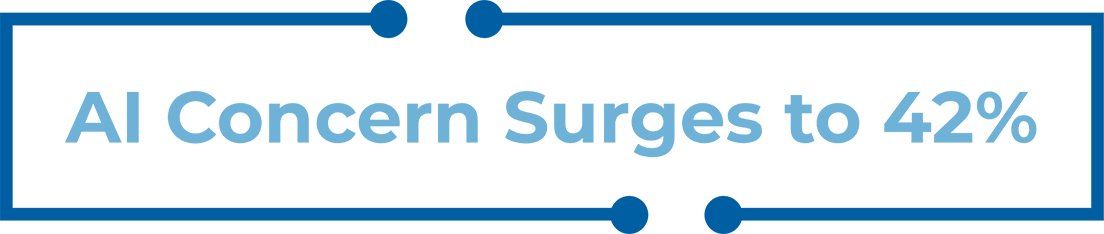
AI and machine learning also moved sharply higher, rising from 30% in 2025 to 42% in 2026 – the biggest year-over-year move among the leading concerns. This raises an important question for IBM i businesses: how can they use AI to extend scarce expertise without assuming AI replaces the experience required to run complex IBM i environments?
Fortra links the growing skills concern directly to increased interest in AI and modernization tools, including IBM Bob.
September 30, 2026, Brings Two Important Support Transitions
IBM i 7.3 standard support ended in 2023. Organizations that remained on 7.3 have been operating under IBM i 7.3 Service Extension.
That first Service Extension ends September 30, 2026. That’s the same date standard support ends for IBM i 7.4.
Organizations remaining on IBM i 7.3 after that date can move to IBM i 7.3 Extended Service Extension, which runs through September 30, 2028, or plan an upgrade to a newer supported release.
For IBM i 7.4 businesses, the decision has a little more runway but still requires planning.
IBM i 7.4 Service Extension begins October 1, 2026, and runs through September 30, 2029. That provides a bridge, but it also marks the point at which organizations should be actively evaluating their long-term version strategy.
For organizations running Infor LX or BPCS, the decision between Service Extension and an upgrade to IBM i 7.5 or 7.6 isn’t just an OS decision. IBM documents support for Infor LX 8.4.2, 8.4.1, 8.4.0, and 8.3.5 on IBM i 7.5. Organizations need to understand application compatibility, customizations, and dependencies before moving the OS. A provider focused only on the IBM i infrastructure layer may not be positioned to assess the ERP application implications.
Upgrade planning and application compatibility assessment therefore need to happen together. That is why the application-layer scope of a managed services provider’s application-layer scope matters more as organizations approach these support transitions.
Organizations on 7.4 that have not yet started an upgrade assessment may already be compressing their planning window. Complex IBM i environments can require several months to assess, test, and safely execute an OS upgrade, particularly where BPCS customizations, job schedulers, and batch dependencies are involved.
What IBM Bob Does – and Where Expertise Still Matters
IBM announced the global availability of IBM Bob on April 28, 2026.

Bob is an AI-first development partner designed to support work across the software development lifecycle, including modernization, code understanding, refactoring, testing, and documentation. IBM reports that surveyed internal users self-reported an average 45% productivity gain across modernization, security, and new development work.
MEDHOST has also reported estimated effort reductions of up to 50% in beta use cases compared with manual coding, including analysis and modernization work in IBM i environments.
The practical point is that Bob is designed to augment development teams, not replace accountability for production systems. Its value is highest when experienced people can review, validate, and apply its output within a real IBM i environment.
The managed services implication follows directly: Bob can amplify experienced IBM i developers. Organizations without sufficient IBM i expertise may struggle to realize its full value, particularly in environments with decades of custom code and undocumented application logic.
For a manufacturing organization running long-lived BPCS customizations with one senior IBM i professional approaching retirement, AI can accelerate documentation and analysis while that knowledge is still available. It does not remove the need to capture institutional knowledge or build application-layer continuity before key people leave.
For organizations without enough internal IBM i depth, an experienced managed services partner can help them use tools such as IBM Bob more effectively while also providing the application knowledge, documentation discipline, and continuity those tools cannot supply on their own.
What Prepared Organizations are Doing
IBM i organizations moving through 2026 with greater operational confidence tend to share a few common practices.
For many organizations, IBM i remains the authoritative system of record. People with the application expertise to understand what it does and why actively manage the ERP application layer, including Infor LX configuration, RPG business logic, BPCS customizations, manufacturing workflows, and job streams. When the business changes, the ERP can change with it. When a key person retires, configuration knowledge doesn’t have to leave with them.
Internal IBM i expertise, where it exists, can then focus more deliberately on upgrade path assessment, application compatibility, modernization, and the integration architecture connecting IBM i to newer services and platforms.
Seventy percent of respondents to Fortra’s 2026 survey planned to upgrade hardware, software, or both. IBM i 7.6 is part of that conversation because it introduces integrated multi-factor authentication capabilities and other security improvements that are drawing interest from organizations planning their next platform move.
A common modernization strategy is to extend and integrate IBM i rather than replace it outright — preserving the stability of the core platform while improving how applications connect, evolve, and are supported.
Organizations that start the managed services conversation before a key developer retires have a better chance to transfer institutional knowledge, document the environment, and build real redundancy before the transition becomes urgent.
If Version Currency, Staffing Risk, or a Contract Renewal Is Forcing the Question, Start with the Application Layer
VIRTUTEM delivers ERP Managed Services for IBM i to manufacturers and distributors across North America, including organizations navigating the IBM i 7.4 transition with Infor LX and BPCS environments.
If the September 30 support transition, staffing changes, or a managed services contract renewal is driving this decision, the right first step is to understand what is covered today—at both the infrastructure and ERP application layers—and where continuity gaps remain.
Schedule a free consultation with VIRTUTEM to review your current ERP application support model and identify the highest-priority risks and next steps.